
Resource
How to file a water damage insurance claim in Texas
Filing an insurance claim in Texas for water damage can be stressful and confusing. What does your policy cover? How do I prove my loss? What do I do when the insurance adjuster comes? How long does my insurance company have to make a decision? What are my rights? We're going to do our best to answer these questions for you below.
What does a typical Texas homeowner policy cover?
Most Texas homeowner insurance policies will cover sudden or accidental water damage. Damage that is caused by a slow leak over time will often be denied by the insurance company.
There are two things to note here. First, it's not the volume of water that caused your damage that matters, but the time it took for the water to damage your home or property. If a pipe bursts and it causes your kitchen to fill up with water within a couple of hours, your policy will most likely cover it. If, on the other hand, there was a small leak under your sink that you didn't notice for a couple of months, and it caused the cabinet to rot from the inside, your insurance company will likely deny the claim. Most insurance carriers will not cover long-term seepage. Second, while the damage caused by the broken part will most likely be covered, the broken part itself will likely not be covered. If a pipe breaks and causes water damage to your subfloor, the damage to the subfloor will be covered, but the pipe itself likely won't. The best way to find out is to read the water damage section of your insurance policy. If you're still confused after that, call your insurance carrier to see if they can explain it further.
Does my insurance company cover mold?
Most policies will only cover mold up to a certain point.
Make sure to check the mold section of your policy. Often it will only be covered up to $5,000, but that can be increased with an endorsement. Many Texas carriers let you raise that limit with an endorsement, in some cases up to the full policy limit. Keep in mind that the mold limit often includes the cost of mold testing, mold remediation, and tear-out to get to the mold. That can add up fast, so make sure that your structure is dried out as quickly as possible. If the structure is dried out within the first couple days of the water damage, mold will most likely not be a problem.
What do I need to do to prove my loss?
Take pictures and videos, keep damaged materials until the adjuster has seen them or taken pictures of them, keep receipts of all the things you buy to help fix the damage, and write down as much of the timeline of the event as you can.
- Take pictures and videos before you move anything. Capture the source, the water line on the walls, the underside of cabinets, and the wet contents.
- Keep all of the damaged material until the adjuster has seen it or taken pictures of it. If something has to come out for safety or drying, photograph it in place, then bag and label a sample.
- Keep all receipts for things you purchase to help fix the damage, including a hotel if you need one.
- Write down as much of the timeline of the event as you can: when you found the water, when you shut it off, who you called, and when they arrived.
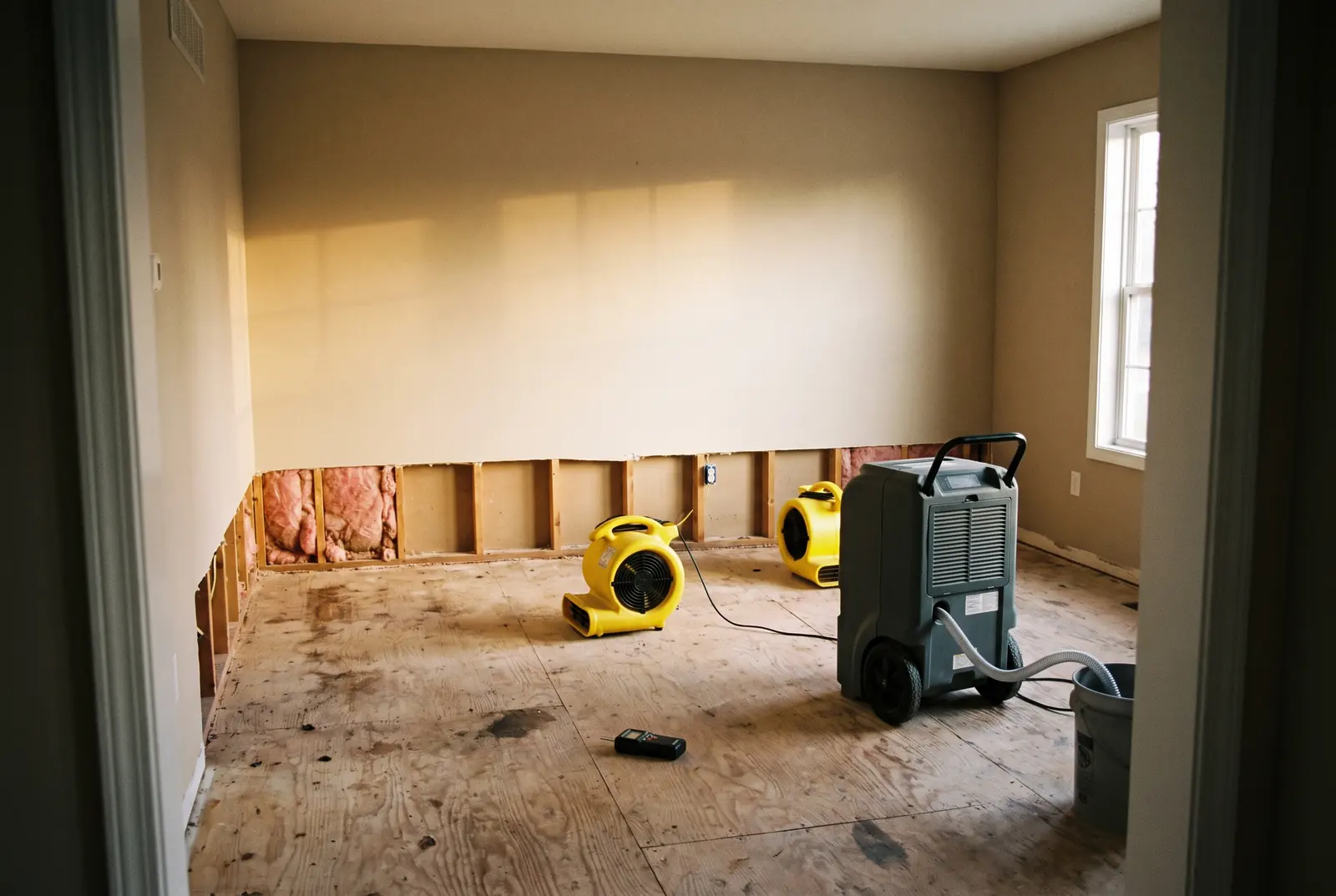
If you hire Guardian to help you with your water damage, we take moisture readings when we arrive, keep track of the drying progress every day, and take pictures of every phase of the job. Our first-hour checklist walks through these steps in order.
What do I need to expect from the adjuster?
The adjuster will come out, check out the damage, and write up a scope and estimate of what your insurance company is willing to pay.
Once you've filed your claim, your insurance company will assign an adjuster to your claim. That adjuster will contact you to set up an appointment to come out and inspect the damage. They will also ask you for any of the documentation you have. Once they've completed their inspection, they will write up a scope and estimate of what your insurance company is willing to pay. This estimate is usually based on software that the adjuster uses. It's important to look over the adjuster's scope very carefully to see what is and isn't included. It's very common for there to be disagreement between the contractor and the adjuster over the scope and the price of the work. Typical sticking points are how much drywall needs to come out, whether flooring in adjoining rooms must be replaced to match, and how many days of drying equipment the carrier will pay for. If this happens, the best way to get the adjuster to pay is to have a very detailed scope that itemizes everything you need. Guardian will write up a scope for you and can talk to the adjuster with you to try to get everything you need approved. We cannot, however, guarantee what the insurance company will pay.
How long does the insurance company have to respond to my claim?
Under the Texas Prompt Payment of Claims Act, the insurance company has 15 days to acknowledge your claim, 15 business days to accept or reject your claim once all of the necessary paperwork has been provided, and 5 business days to pay your claim once it has been accepted.
When the insurance company gets notice of your claim, they have 15 days to acknowledge the claim, start investigating the claim, and let you know what paperwork they need from you to process the claim. Once you've provided the insurance company with all of the requested documents, they have 15 business days to either accept or reject your claim in writing. If they reject your claim, they have to list in the letter why your claim has been rejected. Once the insurance company has accepted the claim, either in part or in full, they have 5 business days to pay you. The insurance company can extend the 15 business days that they have to make a decision on your claim under certain circumstances. They can also start the clock over again if they request additional information from you and it can be reasonably expected that you would have that information. If the insurance company does not abide by these time limits, Texas law requires them to pay you penalty interest and attorney's fees in addition to the amount that they owe on your claim. It's very helpful to keep track of the dates that you talk to the insurance company and the dates that you receive letters from them so that you can prove when their time periods began.
Do I have to use an insurance company's contractor?
No. The insurance carrier cannot force you to use one of their preferred contractors in Texas.
They may suggest using one of their preferred vendors or a managed repair program, but you are not required to use their list of vendors. When using your own vendor, keep in mind that the vendor you choose is working for you and should assist you in documenting your claim as thoroughly as possible. Ask potential contractors about how they deal with insurance claims and the types of documents they supply to help you with the claim (drying logs, etc.). They should be willing to speak directly with the insurance adjuster to help you receive proper compensation for the damage.
What do I do if I don't agree with the insurance company?
There is an appraisal clause in most insurance policies that allows either party to have the insurance company's offer appraised.
Each side will select an appraiser and they will select an umpire who will rule on the damage amount if the two appraisers cannot come to an agreement. You will need to pay for your appraiser, and typically the umpire's fees are split between the two parties. Because of that, using the appraisal clause should only be considered if there is a large difference between your insurance company's offer and what you believe your claim is worth. Appraisal settles how much the repair costs, not whether the loss is covered. If your insurance company is denying or reducing your claim, ask the adjuster for the specific policy language that they are using to justify their position. If you feel that your insurance carrier is not handling your claim fairly, you can file a complaint with the Texas Department of Insurance. The TDI website also has information on their consumer help line that you can use to get assistance with your insurance claim. Another option for a difficult claim is to hire a public adjuster or attorney to review your claim file with you. Please note that this web page should not be considered legal advice.
Is water damage from flooding covered under my policy?
Water damage from a flood (rising water, storm surge, bayou or creek overflow, etc.) is not covered under most standard homeowners insurance policies. You need to purchase a separate flood insurance policy through the National Flood Insurance Program or from a private carrier.
The key difference between water damage and a flood is the source of the water. Water from rain entering through a storm-damaged roof is commonly covered under a homeowners policy. Water that rises from the ground or street and enters the house is considered to be from a flood and is not covered if you don't have flood insurance. A flood claim is handled differently than a standard insurance claim and you will deal with a different adjuster. Keep in mind that a flood insurance policy from the NFIP normally has a 30-day waiting period, so don't wait until storm season to purchase one. Regardless of the type of claim you are filing or whether you have insurance, the mitigation process is the same. Guardian can help you extract the water, remove unsalvageable material, and dry your structure.